In this blog post for the St Andrews Centre for Contemporary Art, Visiting PhD student Pedro Merchán Mateos reflects on his time in St Andrews and his research affiliation with the St Andrews Centre for Contemporary Art.
I am currently a PhD Fellow in the Department of Art History and Art Theory at the Universidad Autónoma de Madrid in Spain. Between September and November 2024, I was a visiting scholar in the School of Art History, University of St Andrews, as part of the Spanish Ministry of Universities’ programme for University Teaching staff Training (FPU). During this time, I was affiliated with the St Andrews Centre for Contemporary Art.
My research focuses on the relationship between feminist and queer activism and art production, institutional discourses and curatorial practice in Spanish contemporary art from the 1990s onwards. During my stay, I developed two chapters of my dissertation regarding the Spanish reception of Queer Theory via cultural institutions and its further transformation into curatorial practices, launching several exhibitions and public programmes across the Spanish State.
I am interested in how nuances in the Spanish context shift from identity politics and representational strategies for queering the museum to policies beyond inclusion relating to infrastructure and governance. I study how some Spanish scholars, curators, and activists encountered theories and critical artistic practices—especially those related to feminist criticism and the AIDS crisis—during their stays in the United States, the United Kingdom and France in the 1980s and 1990s. Upon returning to Spain, where there were no activist or politicised artistic practice or institutional positions, they undertook the task of politicising the cultural sphere by curating exhibitions and creating other temporary relational structures that fostered queer kinship. In this way, the ideas of queer theorists such as Lee Edelman, Simon Watney, Michael Warner and Douglas Crimp were transferred into curatorial positions. I analyse British and European cases of feminist and queer exhibitions, paying particular attention to the creation of structures for care beyond reproduction considering the failure of ‘queer art’ to materialise.
Throughout my stay in St Andrews, I also considered how to approach these queer objects and affects between agents using a queer methodology dealing with extractivism. As the Spanish case shows, there is no epistemological leap—following Bruno Latour’s critique—between the network of agents involved in a queer exhibition and queer theory explaining them, as Queer Theory was received precisely in those institutions, in reading groups and workshops formed by artists, curators, activists and publics. Theory was part of their practice. For this reason, Queer Theory is not applied to a case study, but rather a shared reading is used to build a community in response to how to care for these dissent lives.
In this regard, Dr Catherine Spencer and I organised the St Andrews Centre for Contemporary Art workshop ‘Researching Queer, Trans, and Feminist Approaches to Art and Visual Culture’, which took place on 12 December 2024. The workshop brought together current research on queer, trans, and feminist approaches to art and visual culture by researchers at the Universities and St Andrews and Edinburgh, with a focus on methodologies and approaches, particularly in relation to archives. I shared my research alongside presentations from Richard Bolisay, Evelyn Whorrall-Campbell, Cicely Farrer and Lucy Howie, which formed the basis for group discussion and conversation, which we hope to continue in the future.

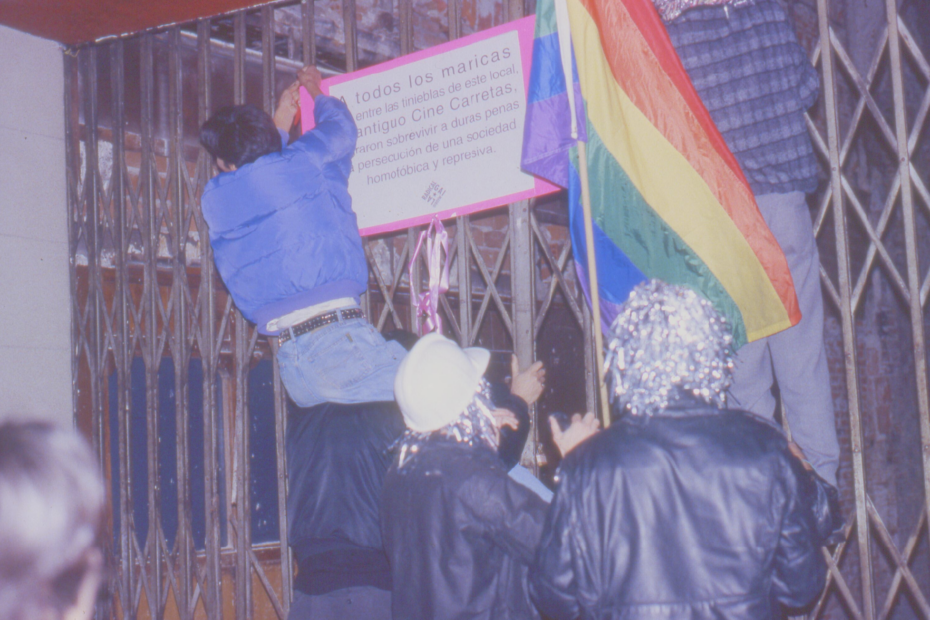
Top image credit: Andrés Senra (1968-), Acción de La Radical Gai en el Cine Carretas (Madrid), Madrid, 1995, ¿Archivo queer?. C00228777c, Copyright: Licencia Creative Commons: Reconocimiento – NoComercial – SinObraDerivada Licencia Creative Commons: Reconocimiento – Nocomercial – Sinobraderivada.